
Last updated: 21 November 2026 · 7 min read
Quick Summary
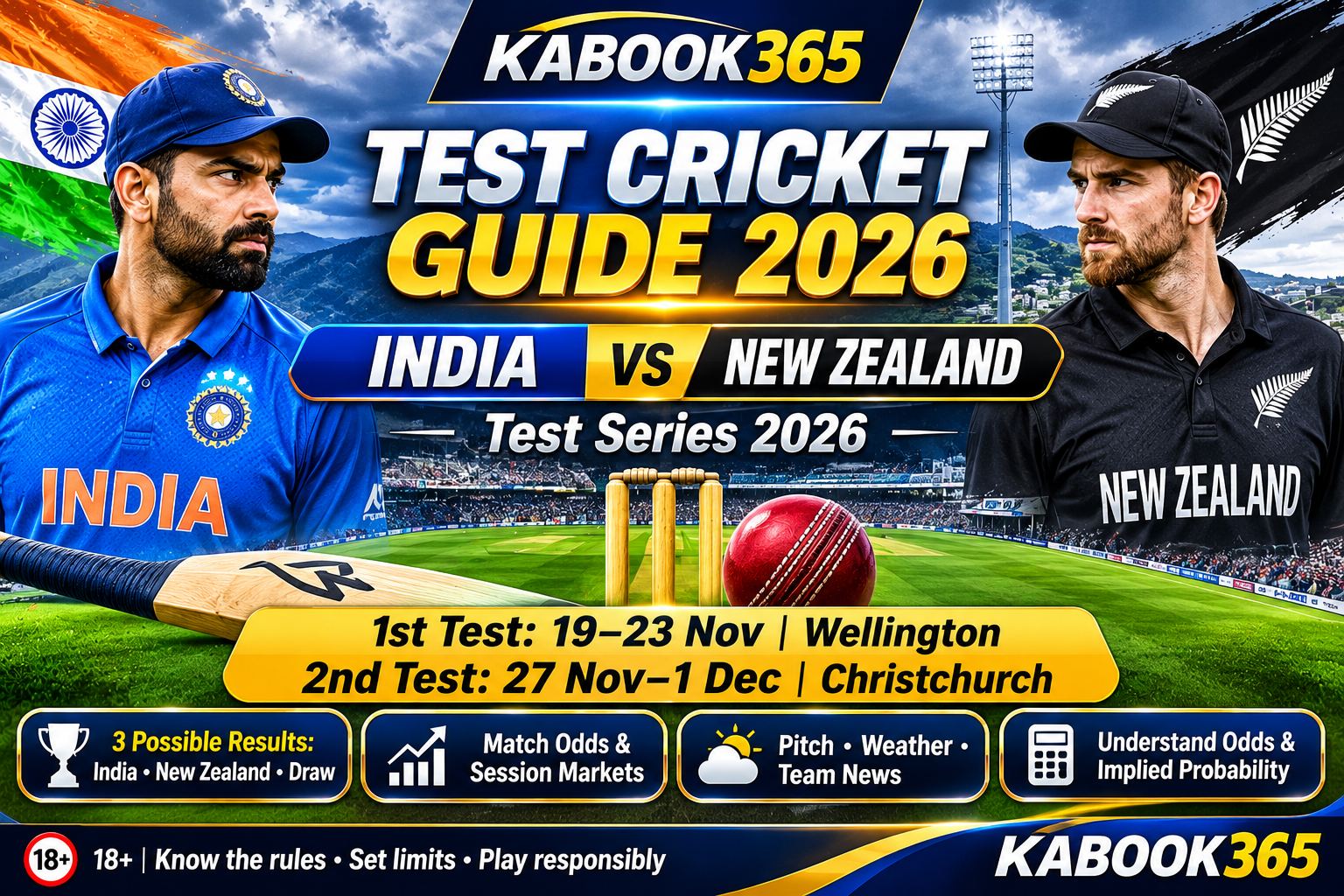
Test cricket betting is different from T20 and ODI betting because a Test match can end in three ways: a home win, an away win or a draw. In the India vs New Zealand Test series 2026, Test 1 runs from 19 to 23 November in Wellington and Test 2 runs from 27 November to 1 December in Christchurch. Both Tests are part of the ICC World Test Championship 2025–27 cycle, so every session matters.
- Three outcomes: India, New Zealand or Draw. The draw price is what most beginners overlook.
- Five days of data: odds move after every session, so patience beats rushing.
- Weather and pitch: lost overs and seam-friendly conditions change the draw probability.
- Stake rule: decide your limit before the toss and never chase a loss.
India vs New Zealand Test Series 2026: Dates and Venues
| Match | Dates | Venue |
|---|---|---|
| 1st Test | 19–23 November 2026 | Wellington |
| 2nd Test | 27 November – 1 December 2026 | Christchurch |
The first Test starts at 3:30 AM IST, so Indian fans usually follow the opening session early in the morning. Check the official schedule from the BCCI, New Zealand Cricket or the ICC for any change in timings before you place a stake.
What Is Test Cricket Betting?
Test cricket betting means backing or laying an outcome in a multi-day, two-innings match where a draw is a real result. A Test can last up to five days, with a minimum of 90 overs scheduled per day, so there are many more turning points than in a T20 or an ODI. Markets are usually open from before the toss until the match ends, and prices keep changing as the game moves.
Why the draw matters
In a T20 there is almost always a winner. In a Test, rain, bad light or a slow pitch can leave a result out of reach. That is why a Test match odds market usually lists three prices, and why the draw can be the most valuable and the most dangerous selection. Always read the market rules on the platform to see how a draw or an abandoned match is settled.
Main Test Cricket Markets Explained
1. Match Odds (India / New Zealand / Draw)
The core market. You choose which of the three results you expect. Prices change after each wicket, session and weather update.
2. Session Markets
A session is roughly one third of a playing day. Session markets ask how many runs a team will score in a set number of overs. They suit fans who watch ball by ball, but they move fast.
3. Innings Runs and Player Markets
These cover a team's first-innings total, or the top bat or top bowler in a match or innings. Bowling-friendly pitches and a strong opening spell can change these prices quickly.
4. Toss Winner
A simple market with two outcomes. In Tests the toss matters mainly because of the pitch and cloud cover on day one.
New to markets and odds? Read our Kabook365 cricket odds guide first for back and lay, decimal odds and bookmaker margin.
How to Read Test Match Odds (With an Example)
Decimal odds convert to an implied probability with one formula: implied probability = 1 ÷ decimal odds. The figures below are illustrative only, not live prices.
| Selection | Example odds | Implied probability |
|---|---|---|
| India | 2.00 | 50% |
| New Zealand | 4.00 | 25% |
| Draw | 4.00 | 25% |
The three probabilities add up to 100% in this example. On a real platform they usually add up to a little more, and the extra is the bookmaker margin. A market that adds up to a much higher figure is poor value.
What Moves the Odds in a Test Match
- Toss and pitch: the team batting first on a seaming pitch can be in trouble early.
- Weather and lost overs: rain or bad light raises the chance of a draw and the draw price shortens.
- Session results: a collapse or a big partnership can shift prices within minutes.
- Team news: injuries, a fifth bowler or a debutant can change the balance.
- Match situation: first-innings lead, the follow-on and the target in the last innings all matter.
Test vs ODI vs T20: Betting Differences
| Feature | Test | ODI | T20 |
|---|---|---|---|
| Possible results | Win, lose or draw | Win or lose (rare no-result) | Win or lose (rare no-result) |
| Match length | Up to 5 days | One day | About 3 hours |
| Pace of odds change | Gradual, session by session | Steady | Very fast |
| Key factors | Pitch, weather, bowling depth | Powerplay, middle overs | Powerplay, death overs |
A Simple Pre-Match Routine for the NZ Tests
- Check the weather forecast for each day of the match.
- Read the pitch report and the toss result.
- Check the playing XIs and any injury news.
- Compare the three prices and convert them to probabilities.
- Set a stake limit you can afford to lose, and stick to it.
Money Rules for a Five-Day Match
- Split your budget across the match instead of using it all on day one.
- Never chase a loss with a bigger stake.
- Avoid staking on every session. Pick a few you understand.
- Take a break between sessions to avoid impulsive decisions.
- Use only the official Kabook365 pages. Never share your OTP, PIN or password with anyone.
Common Mistakes in Test Cricket Betting
- Ignoring the draw: treating a Test as a two-way contest.
- Overreacting to one session: a bad morning does not decide a five-day match.
- Skipping the rules: not checking how rain, abandonment or a draw is settled.
- Betting from a time zone habit: staking half-asleep during early-morning IST sessions.
- Falling for "sure win" claims: no tip, group or page can guarantee a result.
Glossary
- Back: bet that an outcome will happen.
- Lay: bet that an outcome will not happen.
- Session: a block of play in a Test day, about two hours.
- Follow-on: when the team batting second is forced to bat again after a big deficit.
- Draw: the match ends without a winner after five days.
- Implied probability: the chance of an outcome shown by its odds.
Frequently Asked Questions
What is Test cricket betting?
Test cricket betting means placing a stake on an outcome in a multi-day Test match. Unlike T20 or ODI, a Test has three results: a win for either team, or a draw. Markets include match odds, session runs, innings totals and player performance, and prices change throughout the five days.
When is the India vs New Zealand Test series in 2026?
The first Test is from 19 to 23 November 2026 in Wellington, and the second is from 27 November to 1 December 2026 in Christchurch. Both are part of the ICC World Test Championship 2025–27 cycle. The first Test starts at 3:30 AM IST.
Why is there a draw price in Test cricket?
A draw is a genuine result when a match is not finished in five days, often because of rain, bad light or a flat pitch. The draw price shows the market's view of that chance. Check the platform's rules to see how a draw is settled.
What is the best market for beginners in a Test match?
Match Odds is the simplest place to start, because it has only three outcomes. Learn how to read the price and the draw first. Session and player markets move faster and need more experience.
How do I convert odds into a probability?
Divide 1 by the decimal odds. Odds of 4.00 give 1 ÷ 4 = 0.25, or a 25% implied chance. The three outcomes in a Test usually add up to slightly more than 100% because of the bookmaker margin.
Does rain change Test match odds?
Yes. Rain and bad light remove overs, which makes a result harder and pushes the draw price down. Odds often move as soon as a forecast changes, so check the weather for all five days.
How much should I stake on a Test match?
Only an amount you can afford to lose. Set a limit before the match, split it across the days and never chase losses. Betting is for entertainment only and results are never guaranteed.
Is it legal to bet on cricket online in India?
Rules on online betting differ by state and can change. You are responsible for checking the law in your location, and you must be 18 or older. Read our disclaimer and responsible gaming pages before you play.
Final Word
Test cricket rewards patience. Understand the three-way market, respect the draw, follow the weather and pitch, and keep your stakes small and planned. If you are ready to follow the India vs New Zealand series, you can register or log in through the official pages. New here? Start with how to create your Kabook ID and the Kabook login and online gaming guide.
Disclaimer: This article is for information only and is not betting advice. Online gaming is for users aged 18 and above and may be restricted in some regions. Results are not guaranteed and you can lose your stake. Please play responsibly.